
Real estate lead follow-up: how to answer website leads (with reply templates)
The first reply decides most of it. Here’s what to say, six templates to start from, and a follow-up rhythm you can actually keep.
Short answer
Reply to a website lead the same hour if you can, and the same day at the latest. Answer the question they actually asked, add one clear next step, and keep it short. If they don’t answer, follow up about two days later and once more about a week later, then stop unless they’ve agreed to hear from you. Keep the enquiry, your replies, their answers and your notes together on one record, so you always know where each lead stands.
Someone fills in a form on your website at 9 pm. They’re interested now, they’ve probably written to more than one agent, and the first helpful answer usually gets the conversation. Follow-up isn’t complicated, but it does go wrong in the same few ways: the reply comes late, it doesn’t answer the question, or nobody remembers to write a second time. This guide covers what to say, six templates to start from, and a rhythm you can keep.
What a good first reply does
- It’s fast. The same hour if you can, the same day at the latest. A plain, quick answer beats a polished one tomorrow.
- It answers what they asked. If they asked whether the basement is finished, say so. “Thanks for your interest, when can we talk?” reads as a script and gets ignored.
- It has one next step. Two specific times for a showing or a call. One question, not five.
- It’s short. A few sentences they can read on a phone.
- It sounds like you. Use their first name and your own, and sign with a phone number.
Six reply templates
Copy these and change the parts in [square brackets]. They’re starting points: the more of your own voice and the client’s actual question you put in, the better they work.
1. A question about a listing
They asked whether a home is still available, or something specific about it.
Hi [first name],

Thanks for asking about [address]. Yes, it's still available. [Answer their question in one or two sentences.]

Would you like to see it? I can show it [day] at [time] or [day] at [time].

[Your name]
[Your phone]
2. A showing request
They asked to see a home.
Hi [first name],

Happy to show you [address]. I have [day] at [time] or [day] at [time]. Does either work?

If you're seeing other homes the same day, tell me which and I'll line them up in one trip.

[Your name]
[Your phone]
3. A home valuation request
A homeowner wants to know what their place could sell for.
Hi [first name],

Thank you for asking about the value of your home at [address]. To give you a number you can rely on, I'd like to confirm a few things:

- bedrooms and bathrooms
- any renovations in the last five years
- when you're thinking of selling, if you are

A 15-minute visit gives the most accurate figure. Would [day] or [day] suit you?

[Your name]
[Your phone]
4. A general "I’m looking to buy" message
They wrote through your contact form without naming a home.
Hi [first name],

Thanks for getting in touch. I'd be glad to help you find a home in [area].

So I only send you places worth your time: what's your price range, and what are your two or three must-haves?

If it's easier to talk, I'm free [day] at [time].

[Your name]
[Your phone]
5. The nudge, two days later
You replied and heard nothing.
Hi [first name],

Just making sure my reply about [address / your question] reached you. [One new, useful fact: a price change, an open house, a similar home.]

No rush on your side. I'm here when you're ready.

[Your name]
6. The last note, about a week later
Still nothing. This one closes the loop politely.
Hi [first name],

I don't want to crowd your inbox, so this is my last note for now. If [address / your search] is still on your mind, reply any time and I'll pick it up from here.

Wishing you all the best with the search.

[Your name]
A follow-up rhythm you can keep
| When | What | Template |
|---|---|---|
| Same hour | The first reply: answer the question, offer one next step. | 1 to 4 |
| About 2 days later | A short nudge with one new, useful fact. | 5 |
| About a week later | A polite last note that leaves the door open. | 6 |
| After that | Stop, unless they answered or agreed to hear from you. |
If they left a phone number and asked for a showing, call or text as well as emailing. If they wrote a detailed question, answer in writing first, then offer a call.
Keep the whole conversation in one place
Most missed follow-ups aren’t about effort. The pieces are scattered: the enquiry is in one place, your reply is in your sent mail, their answer is somewhere in your inbox, and the detail you meant to remember (“pre-approved, wants a yard”) is on a sticky note. A week later you can’t tell who is waiting on whom.
Whatever tool you use, each lead should have one record with:
- what they asked, and which page or listing they were on
- every reply you sent, with the date
- what they wrote back
- your own private notes
- where it stands: new, contacted, or closed
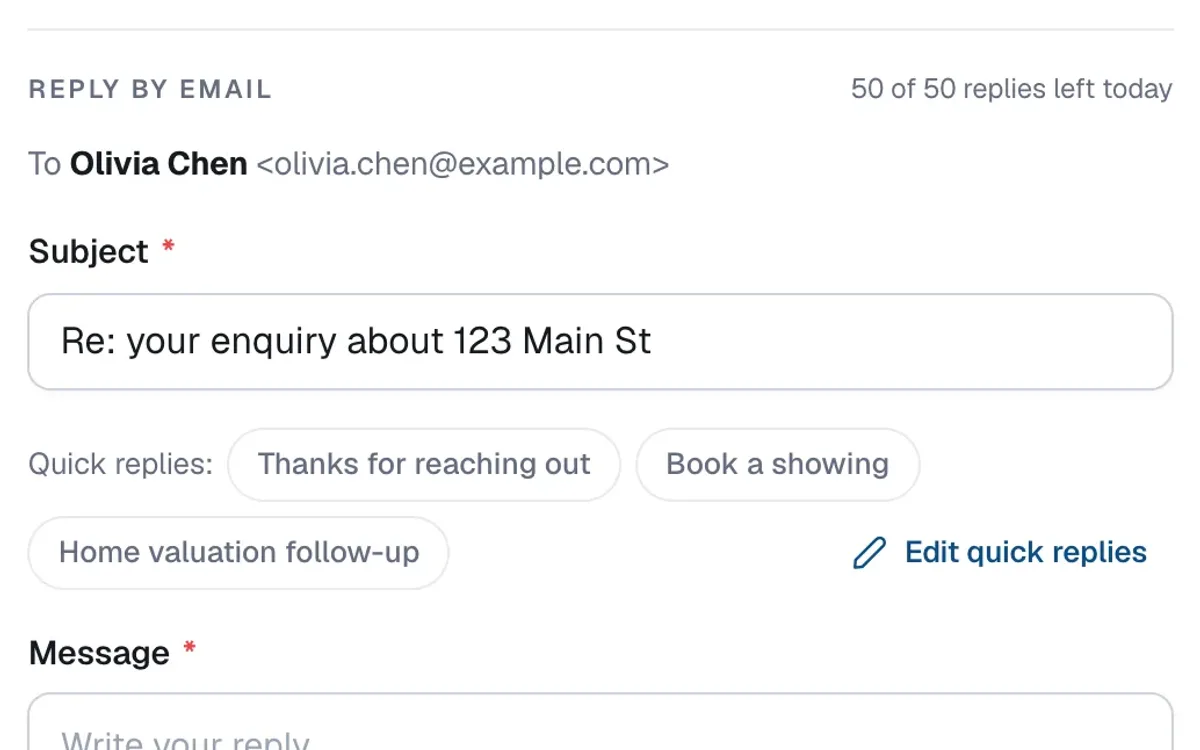
On a RealtyTerminus website this is the Leads inbox, included on every plan. Every form on your website lands there, you reply from the lead itself, and when the client answers, their email is saved on the same lead (and still reaches your own inbox). Quick replies give you a starting point, private notes sit beside the conversation, and replying marks the lead Contacted for you. If you already use a CRM, every new lead can go there automatically.
What Canada’s anti-spam law means for follow-up
- Replying to an enquiry is fine. They asked you a question; answering it is what they expect.
- Later marketing needs consent. Under Canada’s anti-spam law (CASL), an enquiry generally gives you implied consent to send that person commercial emails for six months. After that you need their express consent, such as a ticked “email me new listings” box.
- Every commercial email identifies you (your name, your brokerage, a mailing address and a way to reach you) and has an unsubscribe that works.
- Honour “stop” quickly. If someone asks not to be contacted, take them off your list.
A plain-language summary as of November 2026, not legal advice. See the CRTC’s guidance on CASL and follow your brokerage’s policy.
Do you need a CRM?
Not to start. If you get a handful of website leads a month, an inbox that keeps each conversation together is enough, and it’s one less tool to learn. A CRM earns its place when you’re tracking a pipeline of dozens of active clients, running drip campaigns with consent, or working as a team that hands leads to each other. When you get there, keep your website sending every new lead into it so nothing is typed twice.
Questions
How fast should I reply to a real estate lead?
As fast as you reasonably can: the same hour is a good target, and the same day at the latest. Someone who just sent an enquiry is still thinking about it, and has often written to more than one agent.
What should the first reply say?
Three things: thank them by name, answer the question they actually asked, and offer one clear next step, such as two times for a showing or a quick call. Keep it to a few sentences.
How many times should I follow up?
A simple rhythm is the first reply, a short nudge about two days later, and one more about a week later. After that, stop unless they have answered or agreed to hear from you.
Is it legal to keep emailing a lead in Canada?
Replying to their enquiry is fine: they asked. For later marketing emails, Canada’s anti-spam law (CASL) generally treats an enquiry as implied consent for six months, and every commercial email needs your name, a mailing address and a working unsubscribe. This is a plain-language summary, not legal advice.
Should I call or email?
Use what they gave you and what they asked for. If they left a phone number and asked about a showing, a call or text is usually fastest. If they wrote a detailed question, answer by email so they have it in writing, then offer a call.
Do I need a CRM to follow up properly?
Not to start. You need every enquiry in one place with your replies, their answers and your notes. On RealtyTerminus that’s the Leads inbox, on every plan. If you already use a CRM, every new lead can be sent there automatically.
Where do my website leads go on RealtyTerminus?
Into Leads, in your admin, and to your email. Each lead keeps your replies, the client’s emailed answers and your private notes together, and is marked New, Contacted or Archived.