
Single property websites for realtors: what they are and what to include
One home, one address, one job: getting the right buyers to book a showing. Here’s what goes on one, and two ways to get it.
Short answer
A single property website is a small website for one listing, usually on its own domain such as 123mainstreet.com. It shows the home’s photos, video, details, map and open houses, and has a form to book a showing. On RealtyTerminus every listing already gets its own page on your website; a single property website on its own domain is a service our team sets up for you, at $5 a month, billed yearly ($60 a year) per property plus a one-time setup fee. You own the domain.
A single property website is a small website about one home for sale, usually on its own domain like 123mainstreet.com. You put the address on the sign, the feature sheet and your social posts, and every buyer who types it lands on that home and nothing else. This guide covers when one is worth it, what to put on it, and the two ways to get one.
When a single property website is worth it
- Luxury and one-of-a-kind homes, where the story, the photos and the video sell the property.
- New developments and presales, with floor plans, a sales centre and a register-your-interest list.
- Homes with heavy print and sign marketing, where a short, memorable address beats a long link.
- Sellers who want to see the effort: a dedicated website is easy to show at a listing presentation.
For most listings, a good listing page on your own website does the same job: it has its own link to share, its own photos and details, and a form to book a showing. It also shows buyers your other listings.
What to put on a single property website
- A big first photo and the address, with the price and the key facts (beds, baths, size) right under it.
- The full photo gallery, in the order a buyer would walk through the home.
- A video or virtual tour, if you have one.
- The description and details: rooms, features, taxes, strata or condo fees where they apply.
- Floor plans and a feature sheet to download.
- A map and the neighbourhood: schools, transit, parks and shops nearby.
- Open house dates, kept up to date.
- A short form to book a showing or ask a question, plus your name, photo, phone and brokerage.
- Your brokerage name and the required disclaimers: it’s advertising, so the usual rules apply. See our new realtor website checklist.
Two ways to get one
| Listing page on your website | Single property website (custom) | |
|---|---|---|
| Address | yourwebsite.com/listings/… | Its own domain, e.g. 123mainstreet.com (you own it) |
| Who builds it | You, in a few minutes: add the listing, photos and open houses | Our team, from your photos and details |
| Design | Your website’s template | Made for that property |
| Showing requests | Your Leads inbox and email | Your Leads inbox and email |
| Shows your other listings | Yes | Links to your main website |
| Price | Included in your plan | $5 a month, billed yearly ($60 a year) per property, plus a one-time setup fee |
A listing page on your RealtyTerminus website
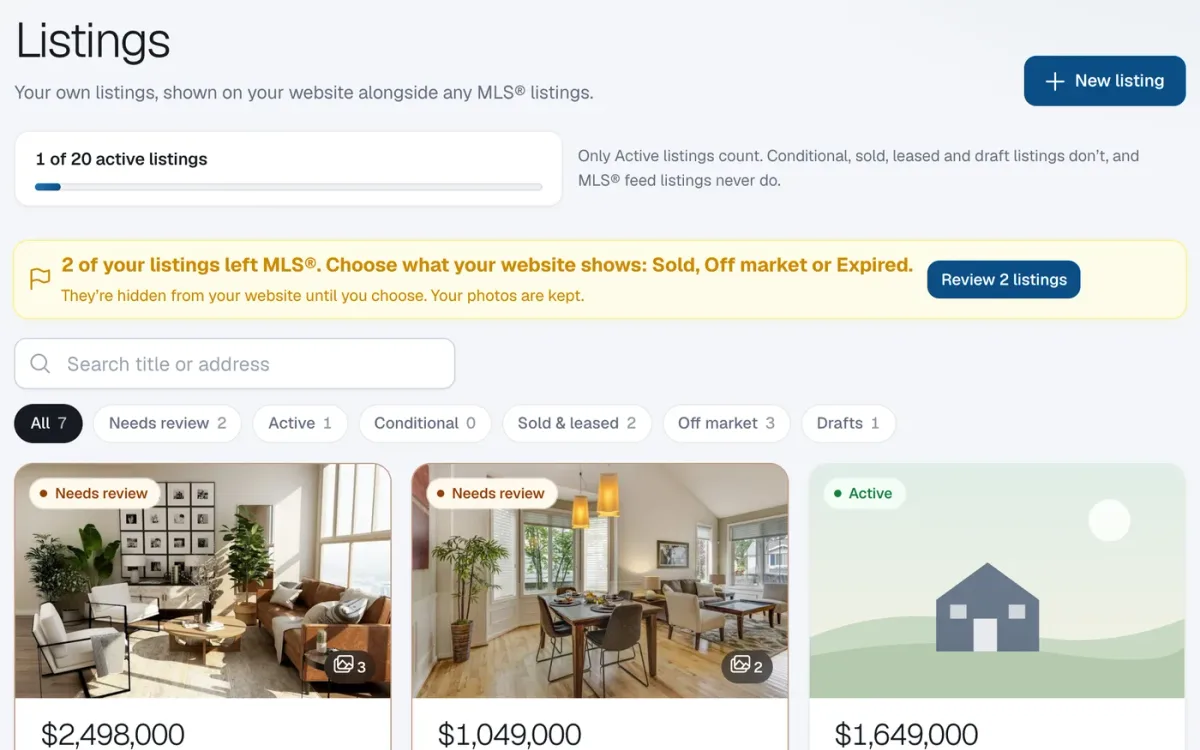
Every listing you add gets its own page on your website, with the gallery, details, map, open houses and a showing request form. On the MLS plan your MLS® listings get pages automatically. When the home sells, mark it as sold and it stays on your website with a Sold label, without the price. See how to add a listing.
A single property website, built for you
When a property deserves its own address, our team can build a single property website for it on its own domain. It’s $5 a month, billed yearly ($60 a year) per property (plus a one-time setup fee; CAD for Canadian websites, USD elsewhere; taxes extra). It isn’t a do-it-yourself plan: send us a request with the address and your domain, and we’ll take it from there. You buy the domain from any registrar and it stays yours. Showing requests still come to your Leads inbox and your email, and on to your CRM if you’ve set that up.
Request a single property website
Tips that make it work
- Pick a short domain: the street address, or the building or development name.
- Put it everywhere: sign rider, feature sheet, social posts, email signature.
- Answer fast: a showing request is a buyer who is ready now.
- Plan the end: decide before you launch what the website shows once the home sells.
Questions
What is a single property website?
A website about one home for sale, usually on its own domain (for example 123mainstreet.com), with the photos, details, video, map, open houses and a form to book a showing.
Do I need one for every listing?
No. Most listings do well with a good listing page on your own website. A single property website suits luxury homes, new developments and special properties where a memorable address on signs, print and social is worth it.
Does a single property website help with Google?
It can rank for the address, but a new domain starts with no history. A listing page on your established website often ranks for the address sooner, and it sends the buyer to the rest of your listings too.
Can I get a single property website from RealtyTerminus?
Yes, as a service: our team sets it up for you on its own domain, for $5 a month, billed yearly ($60 a year) per property (plus a one-time setup fee; CAD for Canadian websites, USD elsewhere; taxes extra). Send a request from the contact page (choose “Done-for-you website”) with the address and your domain. You buy and own the domain; we set the website up on it.
What happens when the home sells?
On your own website you can mark the listing as sold so it stays with a Sold label and no price. For a single property website, decide with us whether it shows Sold, points to your main website, or ends.
Where do the showing requests go?
To your Leads inbox and your email, like every other lead, and on to your CRM if you’ve set that up.